Education Center
Here to Help. Always.
Dog days of Summer are here! Stay cool with FREE A/C check + $50 off A/C services.
Plus save up to $120 off Vredestein tires and MORE with rebates!
Book Online!

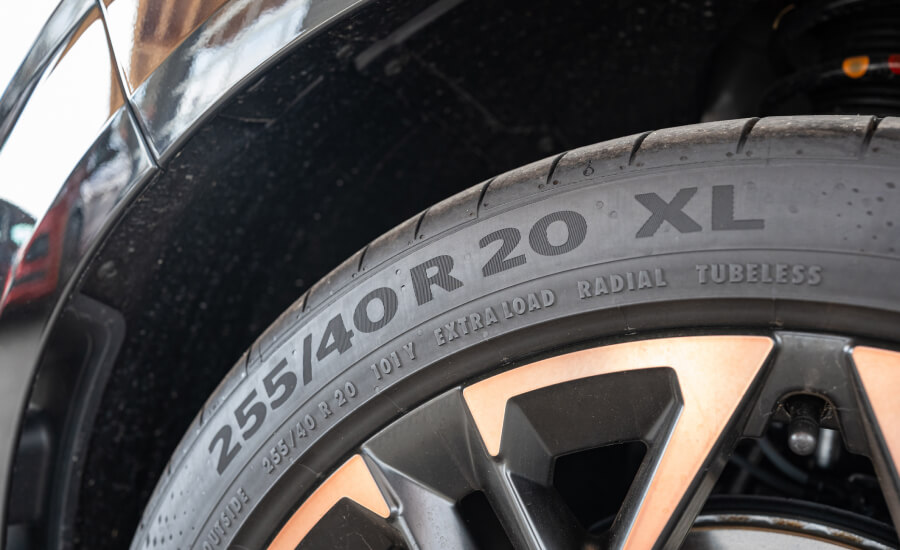
Understanding your tire sidewall may seem like a challenge, but once you know what to look for, those numbers and letters are easy to decode. Whether you’re replacing a tire, buying a new set or just curious about what those codes mean, this guide breaks down everything you’ll find on a tire sidewall so you can choose the right tires for your vehicle.
A tire sidewall is the side of the tire that connects the tread to the wheel. It’s the part you see when you look at your tire from the side, and it includes numbers, letters, and symbols that provide information about the tire’s size, capabilities, and manufacturing details.
Reading your tire sidewall correctly helps you determine whether a tire is suitable for your vehicle. The markings identify key specifications, including tire width, construction type, wheel diameter, and load index, all of which are encoded into a standardized series of numbers, letters, and symbols.
Every tire sidewall includes a code that packs several pieces of information into a single string of numbers and letters. While the numbers and letters on your own tire will differ based on its size and capabilities, the format and order are standardized across most passenger and light truck tires. Once you understand what each marking represents, you’ll be able to read almost any tire sidewall code.
Below is a breakdown of a sample tire code, P215/65R15 95H, so you can see how each part translates into real specifications. Each one is covered in more detail further down.
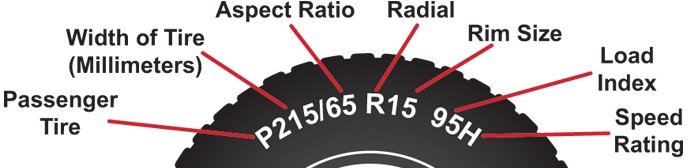
| Marking | Component | What It Means |
| P | Tire type | Passenger vehicle tire |
| 215 | Width | Tire width in millimeters |
| 65 | Aspect ratio | Sidewall height as a percentage of the tire’s width |
| R | Construction | Radial construction |
| 15 | Wheel diameter | Wheel diameter in inches |
| 95 | Load index | Numerical code indicating the maximum load the tire can carry when properly inflated |
| H | Speed rating | Letter indicating the tire’s maximum speed capability under specified conditions |
| DOT tire identification number | DOT XXXX XXXX 2424 | Tire identification number showing the manufacturing plant, tire specifications, and week/year of manufacture |
| Sidewall style | BSW | Black sidewall (other examples include OWL for outlined white letters and RWL for raised white letters) |
Tire sidewall markings provide important information about a tire’s size, construction, and performance. Understanding what each code means makes it easier to identify the right tire for your vehicle.
The letter (or letters) at the beginning of a tire code identifies the type of vehicle the tire is designed for. Common tire type designations include:
Choosing the correct tire type is important because each is engineered for a specific application and load capacity. For example, replacing an LT tire with a P-metric tire of the same size may reduce your vehicle’s load-carrying capability. Unless a tire professional recommends otherwise, it’s best to replace your tires with the same type specified by your vehicle manufacturer.
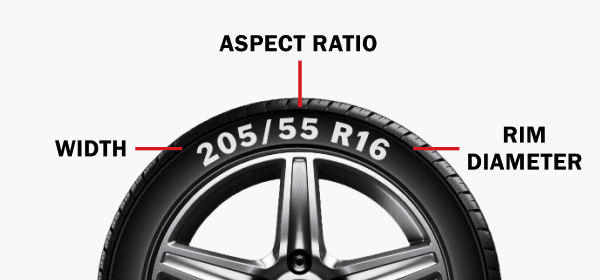
Tire width is the distance from one sidewall to the other at the tire’s widest point when properly mounted and inflated. It’s measured in millimeters, so a width of 235 means the tire is approximately 235 millimeters wide.
In general, a wider tire provides a larger contact patch, which can improve grip and handling on dry roads. A narrower tire may reduce rolling resistance, which can improve fuel efficiency, and often performs better in snow or slush by helping the tire cut through the surface to reach the road below.
When replacing tires, it’s generally best to stay close to your vehicle manufacturer’s recommended width. While it’s sometimes possible to go slightly wider or narrower, the tire must still be compatible with your wheel width, maintain proper clearance, and meet your vehicle’s performance and safety requirements.
The aspect ratio is the height of a tire’s sidewall expressed as a percentage of its width. For example, an aspect ratio of 65 means the sidewall height is 65% of the tire’s width.
A tire’s aspect ratio affects both ride quality and handling. Lower aspect ratios (generally 55 or below) have shorter sidewalls, which typically improve steering response and cornering performance. Higher aspect ratios have taller sidewalls that provide more cushioning, resulting in a smoother, more comfortable ride over bumps and uneven roads.
The construction code identifies how the tire’s internal layers are built. Today, most passenger and light truck tires use radial construction, which is represented by the letter R.
Radial tires are built with reinforcing cords that run perpendicular to the direction of travel, helping improve ride comfort, fuel efficiency, and tread life. While other construction types, such as D (diagonal or bias-ply), are still used for some specialty applications, nearly all modern passenger vehicles are equipped with radial tires.
Wheel diameter is the size of the wheel the tire is designed to fit, measured in inches. For example, a wheel diameter of 17 means the tire is made for a 17-inch wheel.
This measurement must match your wheel exactly. Unlike tire width, wheel diameter isn’t a specification you can adjust without replacing the wheels themselves. Installing a tire with the wrong wheel diameter will prevent it from fitting properly.
Load index refers to the maximum weight a tire can support when properly inflated. Rather than representing a weight directly, each number corresponds to a specific load capacity on a standardized chart.
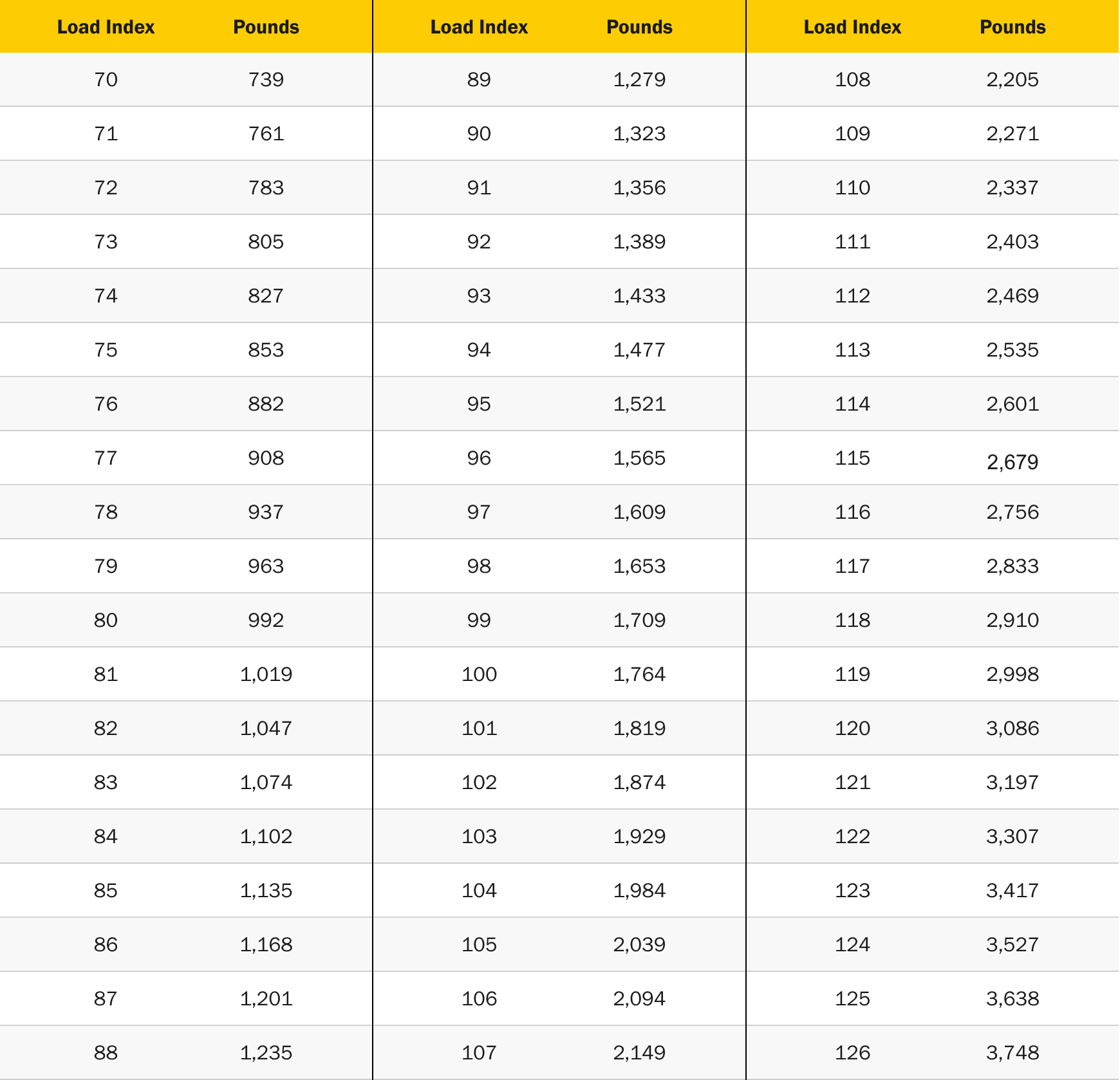
It’s important to choose tires with a load index that meets or exceeds your vehicle manufacturer’s recommendation. Using tires with a lower load index can reduce your vehicle’s carrying capacity and may compromise safety, especially when carrying passengers, hauling cargo or towing.
The speed rating is a letter that indicates the maximum speed a tire is designed to sustain under specified testing conditions. Common speed ratings include S, T, H, V, W, and Y, with higher letters generally corresponding to higher speed capabilities.
While most drivers will never reach these speeds, the rating also reflects characteristics such as handling and heat resistance. When replacing tires, choose a speed rating that meets or exceeds your vehicle manufacturer’s recommendation.
| Speed Rating | Maximum Speed |
| S | 112 mph |
| T | 118 mph |
| U | 124 mph |
| H | 130 mph |
| V | 149 mph |
| W | 168 mph |
| Y | 186 mph |
| (Y) | Over 186 mph |
You may still see ZR in some tire size designations (for example, 275/35ZR19). Historically, Z indicated a tire capable of speeds over 149 mph. Today, ZR is used in the tire size to indicate a high-performance tire, while the actual speed rating is identified separately by W, Y, or (Y).
The Department of Transportation (DOT) code is a series of letters and numbers that identifies where and when a tire was manufactured. The last four digits indicate the week and year of production. For example, 2424 means the tire was made during the 24th week of 2024.
Checking the DOT code can help you determine a tire’s age, which is important because tires naturally deteriorate over time when not stored in climate controlled environments, even if they have plenty of tread remaining.
Some tires include abbreviations that describe the appearance of the sidewall rather than its performance. Common examples include BSW (Black Sidewall), OWL (Outlined White Letters), and RWL (Raised White Letters).
These markings are primarily cosmetic and don’t affect how the tire performs. They simply indicate the sidewall’s design and lettering style, allowing drivers to choose the look they prefer.
Beyond the tire code and DOT number, tires include additional markings that provide information about performance, construction, and design. Here are some of the most common markings you may find molded into a tire’s sidewall.
Treadwear, traction, and temperature grades are part of the Uniform Tire Quality Grading (UTQG) system, which provides standardized ratings for certain aspects of tire performance.
These ratings can help you compare tires, but they should not be the only factor in your decision. UTQG ratings do not measure factors such as dry traction, cornering ability, ride comfort, or performance in all weather conditions.
Max pressure, often printed as “MAX PRESS” or “MAX. INFL. PRESS,” indicates the highest air pressure a tire is designed to safely withstand. It is not the recommended inflation pressure for everyday driving.
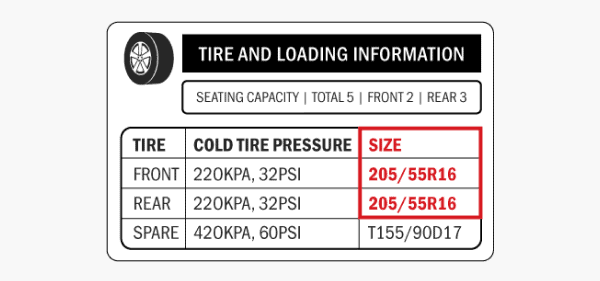
The correct tire pressure for your vehicle is listed on the driver’s side doorjamb or in the owner’s manual, not on the tire itself. Inflating tires above or below the recommended pressure can affect handling, ride comfort, fuel efficiency, and tire wear.
Tires are labeled on the sidewall as either tubeless or tube type to indicate how they hold air. Tubeless tires form an airtight seal with the wheel rim and do not require an inner tube, while tube type tires use an inner tube to contain the air.
Nearly all modern passenger vehicle tires are tubeless, while tube type tires are typically used in specialty applications.
Both 3PMSF (Three-Peak Mountain Snowflake) and M+S (Mud and Snow) markings relate to winter driving conditions, but they represent different standards.
The M+S marking is based on a tire manufacturer’s tread design and does not require standardized winter performance testing. The 3PMSF symbol requires a tire to pass a specific snow traction test, making it a stronger indicator of verified performance in severe snow conditions.
Understanding your tire sidewall is a great first step, but choosing the right replacement tire involves more than matching a few numbers and letters. If you’re unsure which tire is best for your vehicle, our experts can help you find the right fit for your driving needs, budget, and manufacturer’s recommendations.
Tires should generally be replaced based on factors such as tread depth, age, visible damage, and driving conditions. Even if a tire has plenty of tread remaining, rubber can deteriorate over time, so it’s important to inspect older tires regularly and follow your tire manufacturer’s recommendations.
XL, or Extra Load, indicates a tire with reinforced construction designed to carry a higher load than a standard load tire of the same size. If your vehicle requires XL tires, replacement tires should have the same designation to help maintain the proper load capacity.
No, a tire with a higher speed rating does not mean it’s necessarily better. A higher speed rating indicates a tire’s ability to handle higher speeds under specific testing conditions, but it does not automatically mean the tire will provide better performance in every category. Factors such as tread life, comfort, weather performance, and driving needs also matter.
Some vehicles, particularly certain sports cars and performance models, are designed with staggered fitment, meaning different sizes on the front and rear axles. For most vehicles, though, all four tires should match in size unless the manufacturer specifies otherwise.
BSW stands for Black Sidewall and indicates that the tire has a plain black sidewall without any white lettering or decorative markings. It’s a style designation that affects the tire’s appearance, not its performance, size, or capabilities.
OWL stands for Outlined White Letters, a sidewall design where the raised lettering has a white outline instead of being molded in solid black. Some drivers choose OWL tires specifically for a more distinctive or classic look, similar to RWL (Raised White Letters). Like other sidewall style markings, OWL has no effect on how the tire performs or fits your vehicle.
Read More
Read More
Read More
Read More
Be the first to know about deals, rebates, and more!
Log in or Create an account to save vehicles and more.
 All-Season
 All-Weather
 All-Terrain
 Winter
All-Season tires are versatile and suitable for warm and cool climates, but not recommended for extreme hot or cold weather conditions because of specific rubber components.
Like their name suggests, all-weather tires are versatile and can perform well in a variety of weather conditions and can be severe snow-rated.
With bigger treads than traditional all-season tires, all-terrain tires allow for both on and off-roading capabilities.
Winter tires are manufactured to perform well in snow, ice, sleet and other cold weather conditions. Winter tires are typically soft, with an intricate grooved tread pattern — made for holding compacted snow and creating traction — and are severe snow-rated.