Education Center
Here to Help. Always.
Slippery roads are coming! Have confidence your brakes are ready. Save up to $100 on brake service. Turn to VIP!
Book Online!

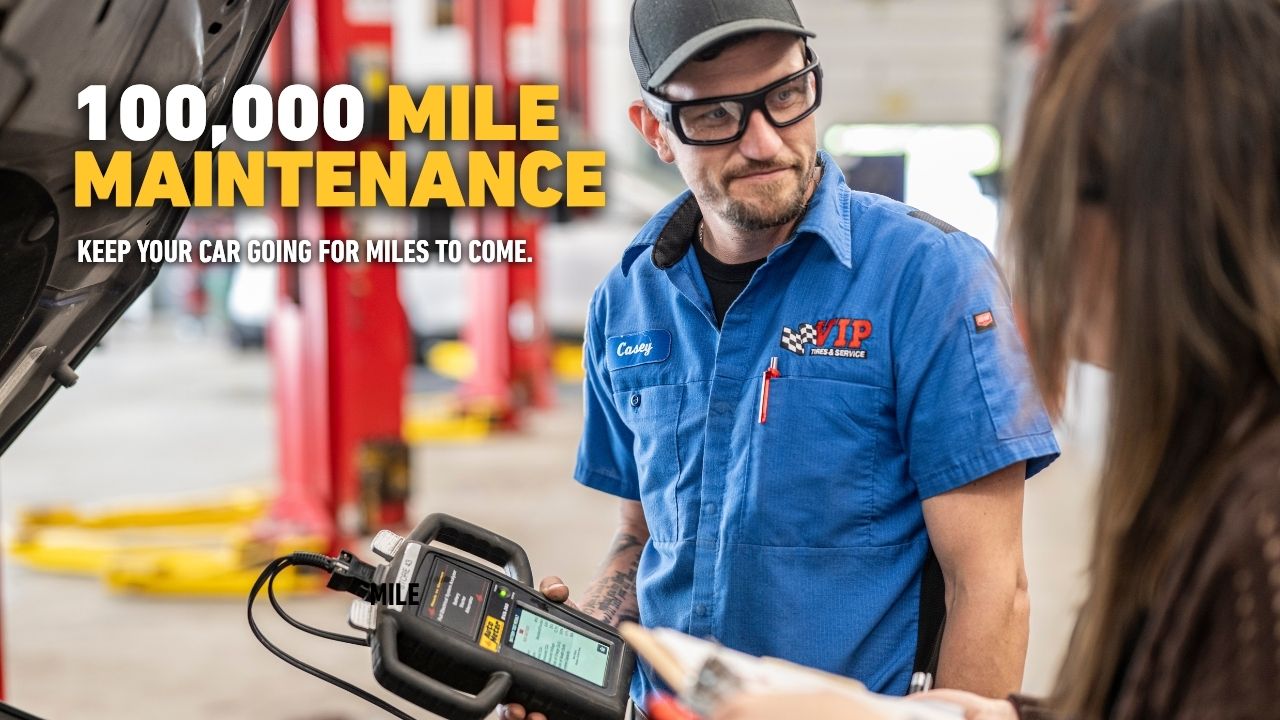
Reaching 100,000 miles is a major milestone for any vehicle. But these days, it doesn’t necessarily mean your car is nearing the end of the road.
In fact, drivers are keeping their vehicles longer than ever. The average age of vehicles on U.S. roads has reached a historic high of about 13 years. With higher vehicle prices, economic uncertainty, and improvements in vehicle quality and manufacturing, more drivers are choosing to maintain the vehicle they already own rather than replace it.
That makes one thing especially important: keeping up with maintenance.
A vehicle with 100,000 miles can still have plenty of life left. Regular maintenance and addressing concerns early can help prevent smaller issues from turning into more expensive repairs down the road.
So, if your vehicle has reached—or is approaching—100,000 miles, what should you do next?
There is no one-size-fits-all “100,000-mile service.”
The maintenance your vehicle needs depends on its make, model, age, service history, and how it has been driven. A vehicle that has spent years driving on rough New England roads may have different needs than one primarily driven on highways. Likewise, some “routine” maintenance may be due well before 100,000 miles, while others may not be needed until later.
Asking our certified technicians is a great place to start. Our teams can recommended maintenance schedules based on your specific vehicle, and following those recommendations can help you understand which services may be due. If you’re unsure what has been completed, or what your vehicle needs next, we’re always here to help take a closer look.
Again, not every vehicle will need every service listed below. However, depending on your vehicle and maintenance history, 100,000 miles can be a good time to check in on several important systems.
Some vehicles use a timing belt, which may require replacement at a manufacturer-recommended interval. A worn or broken timing belt can cause serious engine damage in certain vehicles.
However, not all vehicles have timing belts. Many newer vehicles use timing chains or other systems instead, which is why it’s important to check your owner’s manual or speak with an automotive professional rather than assuming a timing belt replacement is needed.
Coolant helps regulate your engine’s temperature and protect important components within the cooling system. Depending on your vehicle, coolant service may be recommended around the 100,000-mile mark.
Your cooling system should also be checked for leaks, worn hoses, or other concerns that could contribute to overheating.
Your transmission is a major (and expensive!) component of your vehicle. Depending on your manufacturer’s maintenance schedule, mileage, and driving conditions, your transmission fluid and overall transmission system may need attention.
Having the system checked can help identify potential concerns and determine whether a manufacturer-recommended service is due.
Depending on whether your vehicle is front-wheel drive, rear-wheel drive, all-wheel drive, or four-wheel drive, it may have differentials and other drivetrain components that require periodic maintenance.
Fluid condition and manufacturer-recommended service intervals can vary significantly, so your specific vehicle matters.
Spark plugs play an important role in engine performance and efficiency. Some can last well beyond 100,000 miles, while others may require replacement sooner.
If your vehicle is experiencing rough idling, misfires, reduced performance, or difficulty starting, worn spark plugs may be one possible cause, but proper diagnosis is important before replacing parts.
Over time, deposits and normal wear can affect your vehicle’s fuel system. Depending on your vehicle and how it has been driven, your manufacturer may recommend certain fuel-system maintenance.
If you’re noticing reduced performance, poor fuel efficiency, hesitation, or other concerns, our team can help determine whether maintenance or further diagnosis is needed.
After 100,000 miles (and especially after years of New England winters, potholes, and rough roads) steering and suspension components can begin to show signs of wear.
Your vehicle may need to be checked for wear in components such as joints and bushings, as well as other suspension and steering parts.
Signs of a potential concern can include:
These issues shouldn’t be ignored. In addition to affecting ride comfort, some steering and suspension concerns can impact handling and tire life.
At 100,000 miles, it can be tempting to search for a checklist and replace everything on it. But that isn’t always necessary, nor is it the most cost-effective approach.
The best starting point is to consider your vehicle’s manufacturer-recommended maintenance schedule, service history, mileage, and current condition.
At VIP Tires & Service, every customer who comes in for a paid service receives a complimentary Multi-Point Inspection. This gives our certified automotive professionals an opportunity to inspect important areas of your vehicle and identify visible concerns that may need attention.
If you’d like a more comprehensive evaluation of your vehicle, VIP also offers an Advanced Multi-Point Inspection for $50. This more in-depth inspection can be a valuable option for drivers who want a closer look at their vehicle as it reaches higher mileage. Plus, you’ll receive an additional $50 discount on any approved work we do for the same day.
If a warning light is on, your vehicle is making an unusual noise, or you’re experiencing a specific problem, an inspection alone may not provide all the answers.That’s when a diagnostic service may be appropriate.
Our technicians can perform diagnostic testing to help get to the root cause of the issue, properly diagnose the concern, and determine the best solution for your vehicle. Rather than guessing at which part needs to be replaced, proper diagnosis helps ensure you’re addressing the actual problem.
One of the biggest advantages of regular vehicle maintenance is the opportunity to address concerns before they become more serious (and potentially more expensive!).
Ignoring a small leak, worn component, warning light, or unusual noise doesn’t make the problem go away. In many cases, continuing to drive with an unresolved issue can lead to additional wear or damage over time.
That doesn’t mean every recommended service needs to be performed immediately. It means understanding your vehicle’s condition, knowing what maintenance is due, and making informed decisions about what should be addressed.
A vehicle reaching 100,000 miles is no longer the milestone it once was. With proper maintenance, quality repairs, and attention to potential concerns, many of today’s vehicles can continue serving their owners well for years to come.
Whether your vehicle just reached 100,000 miles or has already gone well beyond it, VIP Tires & Service is here to help you understand what it needs to keep moving forward.
At 100,000 miles, don’t just think about how far your vehicle has come. Think about how many more miles are still ahead.
Turn to VIP for the Miles Ahead!
Read More
Read More
Read More
Read More
Be the first to know about deals, rebates, and more!
Log in or Create an account to save vehicles and more.
 All-Season
 All-Weather
 All-Terrain
 Winter
All-Season tires are versatile and suitable for warm and cool climates, but not recommended for extreme hot or cold weather conditions because of specific rubber components.
Like their name suggests, all-weather tires are versatile and can perform well in a variety of weather conditions and can be severe snow-rated.
With bigger treads than traditional all-season tires, all-terrain tires allow for both on and off-roading capabilities.
Winter tires are manufactured to perform well in snow, ice, sleet and other cold weather conditions. Winter tires are typically soft, with an intricate grooved tread pattern — made for holding compacted snow and creating traction — and are severe snow-rated.