Education Center
Here to Help. Always.
Buy 4 tires installed with Tire Maintenance++ and an alignment – save $100 INSTANTLY!
Shop today!

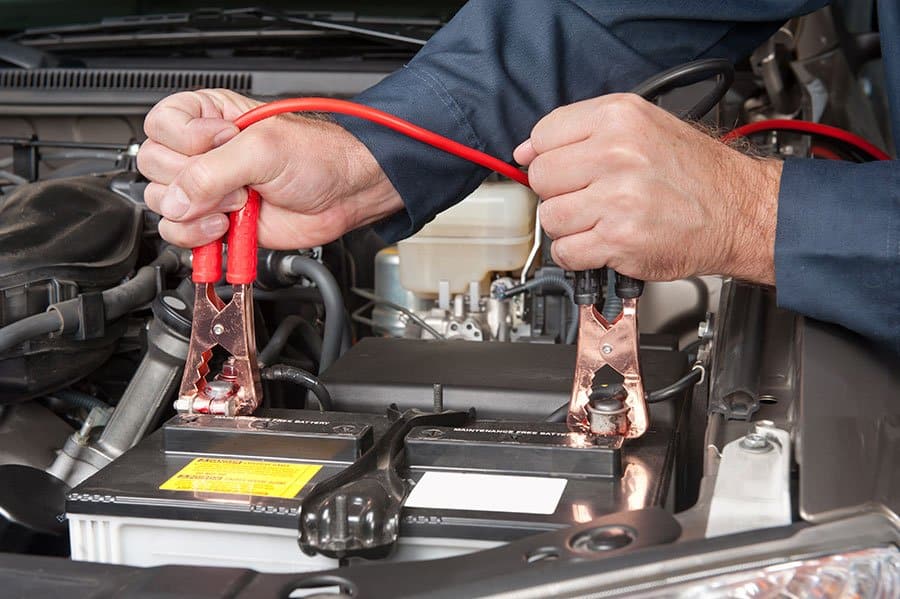
In the world of automotive emergencies, motorists need to learn certain procedures for “safety’s sake.” Two of the most valuable lessons, changing a tire and hooking up jumper cables are best learned before an emergency arises, according to the Car Care Council.
The process of boosting a battery is especially important in cold weather. Jumper cables or cables on a portable battery booster should be connected properly to avoid sparks, which can cause an explosion of the hydrogen gas emitting from a battery. Beyond this, an incorrect hook up can damage critical, and expensive, electronic components.
The procedure is simple:
Connect the positive (+) clamp to the positive terminal of the healthy battery and the other positive clamp to the corresponding terminal of the dead battery.
Next, the negative (-), or ground, terminal on the good battery and, finally, the negative clamp to the engine block, frame or other grounded metal as far as possible from the battery. You want to avoid sparks in the vicinity of the explosive hydrogen gas that emits from the battery. Do not connect it to the ground terminal (negative).
When using a portable battery booster, the process is much the same.
Connect the positive clamp of the booster cable to the positive clamp of the dead battery. Then connect the negative cable to the engine block or other grounded metal away from the battery.
The Council offers an additional suggestion: if you are buying jumper cables or a portable battery booster, buy the best quality you can afford. Look for well-insulated clamps and 8-gauge wire. (Note: the lower the wire gauge number, the heavier the gauge.) Under the heavy electrical load of boost starting, lightweight cables may not be able to deliver enough current to start some engines. In fact, they have been known to melt in the user’s hand.
If your battery is three-years old or older and you haven’t had it checked, it’s a good preventive measure to do so, suggests the Council. A battery’s power is reduced as the temperature drops. And that’s when the engine’s starting demands are greatest.
Visit us at one of over 70+ locations throughout the Northeast. Walk-ins Welcome!
Schedule Service Get a Free QuoteRead More
Read More
Read More
Read More
Be the first to know about deals, rebates, and more!
Log in or Create an account to save vehicles and more.
 All-Season
 All-Weather
 All-Terrain
 Winter
All-Season tires are versatile and suitable for warm and cool climates, but not recommended for extreme hot or cold weather conditions because of specific rubber components.
Like their name suggests, all-weather tires are versatile and can perform well in a variety of weather conditions and can be severe snow-rated.
With bigger treads than traditional all-season tires, all-terrain tires allow for both on and off-roading capabilities.
Winter tires are manufactured to perform well in snow, ice, sleet and other cold weather conditions. Winter tires are typically soft, with an intricate grooved tread pattern — made for holding compacted snow and creating traction — and are severe snow-rated.